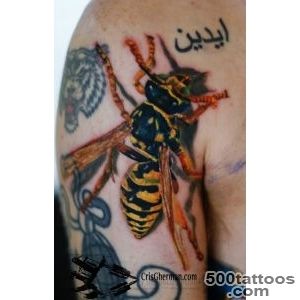
Wasp tattoo

Bees get all the love - community, honey, golden warmth. The wasp gets respect instead: sharp, territorial, fearless relative to its size, and absolutely willing to sting more than once. A wasp tattoo appeals to people who identify with that energy - focused, independent, and unapologetic about defending their space.
Sharp, territorial, fearless: what a wasp says about you
A wasp does not sting for fun; it stings to protect something it values. That makes the insect a natural symbol for determination, self-protection, and the willingness to act decisively when pushed. Some wearers connect it to a period in their life when they had to fight for their boundaries. Others choose the wasp purely for its clean, aggressive aesthetic - narrow waist, angular wings, vivid yellow-and-black stripes. Either way, the tattoo projects a personality that is precise rather than reckless.
Scientific illustration, blackwork, or realism - three directions
A scientific-illustration approach treats the wasp like a specimen plate: fine-line legs, labeled anatomy, stippled shading, and a neutral background. It appeals to biology fans and gives the piece an intellectual edge. Blackwork strips the insect down to bold stripes and strong silhouette, making it graphic and punchy even at small sizes. Realism goes the opposite direction - glossy exoskeleton, translucent wing veins, dewdrops on the body - creating a piece that looks like the insect just landed on your skin. Watercolor adds smoky yellows and soft backdrops that take the sharpness down a notch without losing the identity.
Adding context: honeycombs, flowers, and geometric frames
A wasp on its own is a clean, standalone image. Adding a honeycomb pattern behind it creates depth and texture. Flowers - especially dark ones like dahlias or anemones - provide a natural setting that softens the aggressive tone. Geometric framing (hexagons, triangles, or circular borders) turns the wasp into an emblem or crest. Pairing two wasps facing each other creates a symmetrical composition that works well on the chest or upper back.
Keeping thin legs and fine stripes crisp through healing
Wasp tattoos live and die on line quality. The legs and antennae are thin, the stripes need clean edges, and the wings rely on subtle shading. Go big enough that those details have room to breathe - a three-centimeter wasp may look perfect fresh but can blur into a dark blob within two years. Expect more sensitivity on the wrist and inner forearm than on the outer arm or shoulder. Use unscented moisturizer during healing and keep the area out of direct sun until fully settled.
Browse 48 wasp tattoo photos below
Compare blackwork silhouettes, realistic macro-style wasps, fine-line scientific illustrations, and watercolor variations. Notice how background elements like honeycombs and flowers change the overall mood of the same insect.
Wasp tattoo designs and images